In 1804, when the book Picture Book Annual Events of the Green Houses (Seirō ehon nenjū gyōji) was published in Japan, who would have guessed that ninety years later it would take Europe by storm? However, by 1891, this two-volume set of books illustrating the annual festivities of the licensed pleasure quarters (Yoshiwara), was not only well-known, but celebrated as a masterpiece. More importantly, it was among the works by the artist, Kitagawa Utamaro (ca. 1763-1806) that had a profound effect on a group of artists that came to be known as the Impressionists.
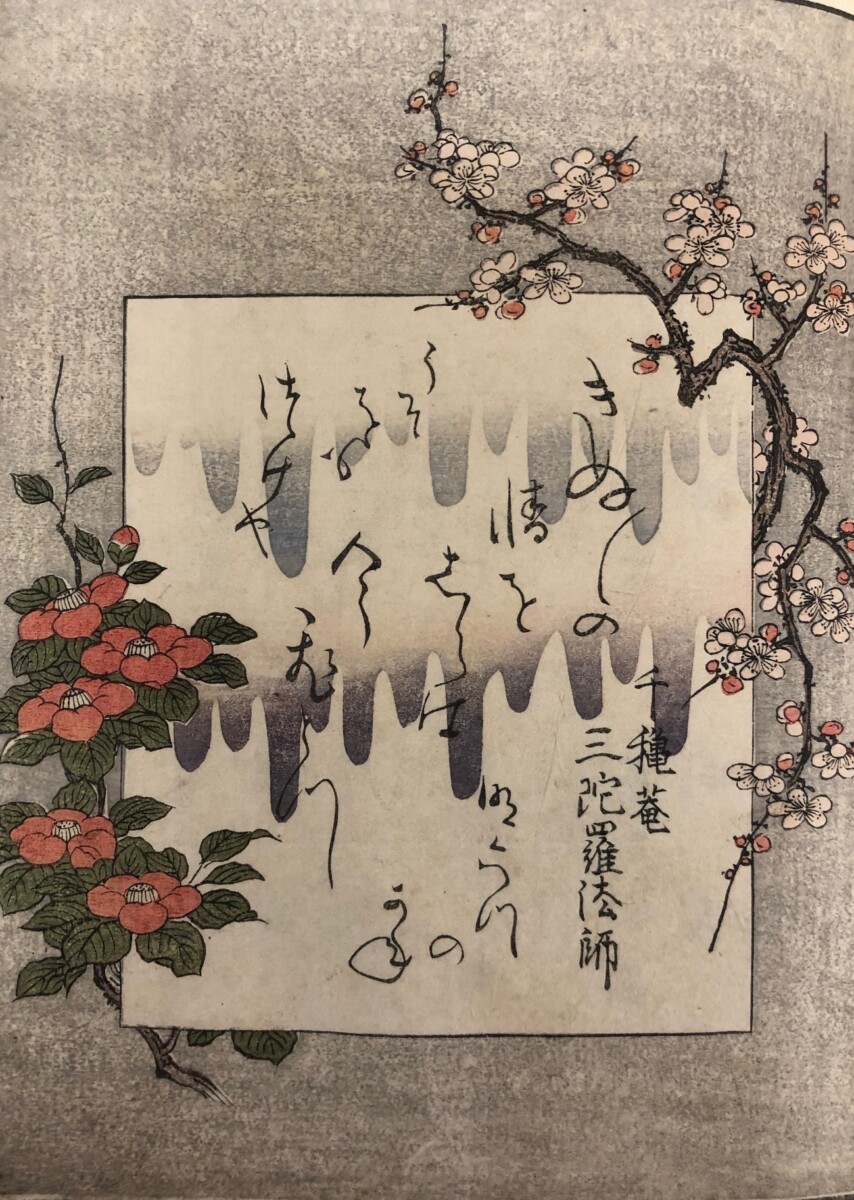
Frontispiece of Plum and Camellia,
with a poem by Senkian Bōshi, from volume 1.
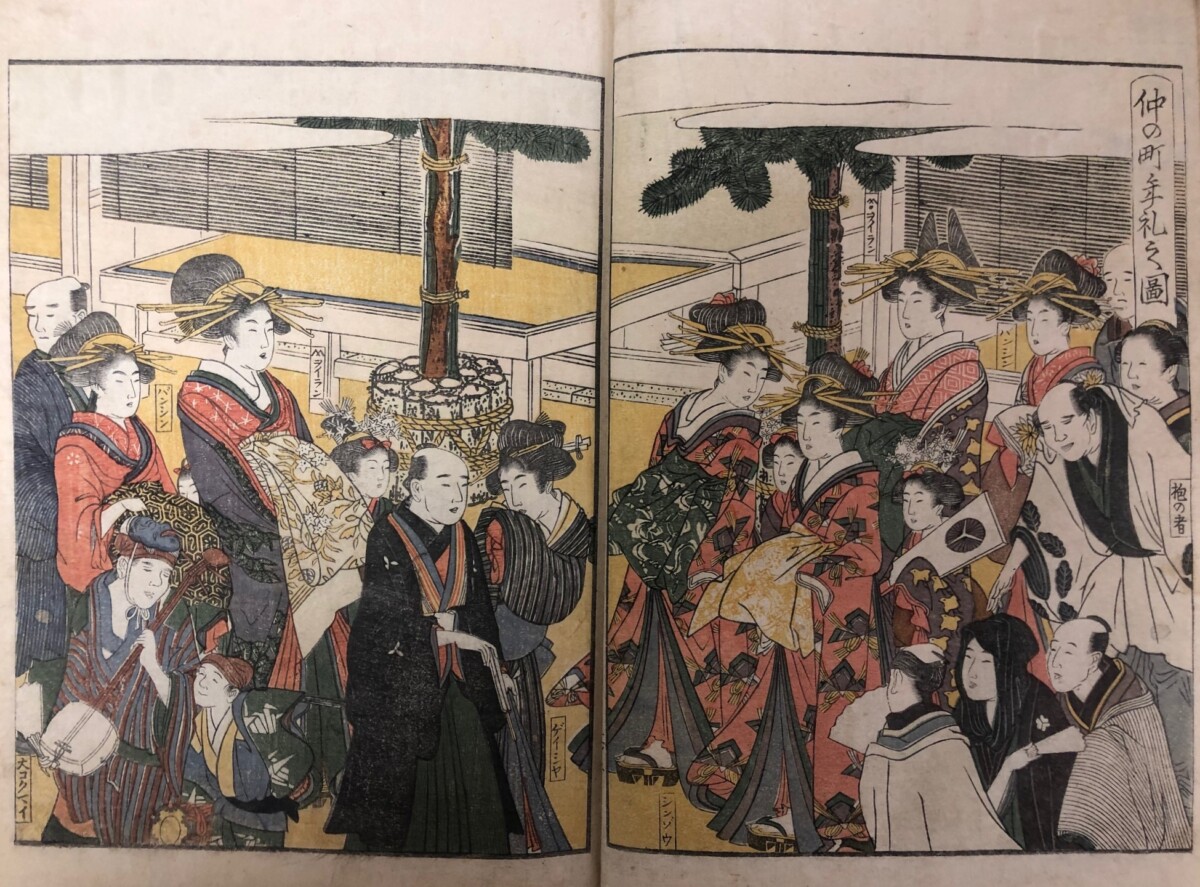
The delivering of New Year’s gifts in Nakanochō, the main street of Yoshiwara.
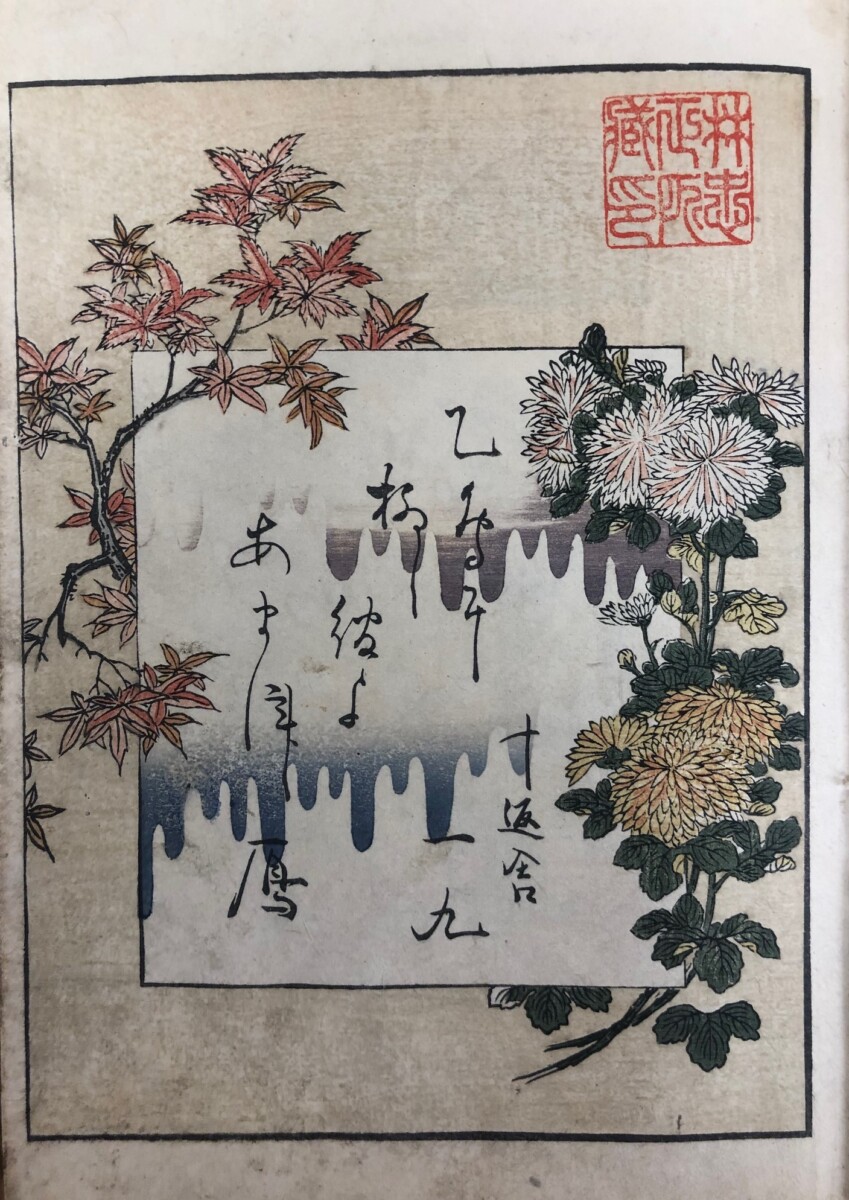
Frontispiece of Chrysanthemum and Maple,
with poem by Jippensha Ikkū, from volume 2.
The two-volume set of woodblock-printed books first enjoyed great popularity when it was published at the beginning of the 19th century in Japan. It was written by one of the stars of the literary world, Jippensha Ikkū (1765-1831) [1] and illustrated by the legendary artist Utamaro. The publisher was so confident in the book’s success that he not only printed two versions—one, like this, in color and a cheaper version in black & white—but also announced a sequel in the advertisements at the end of the book. Anecdotal reports, however, suggest that, after publication of these first volumes, there was an argument between Ikkū and Utamaro about which of them was responsible for the book’s popularity, which ended the collaboration and the possibility of this sequel.
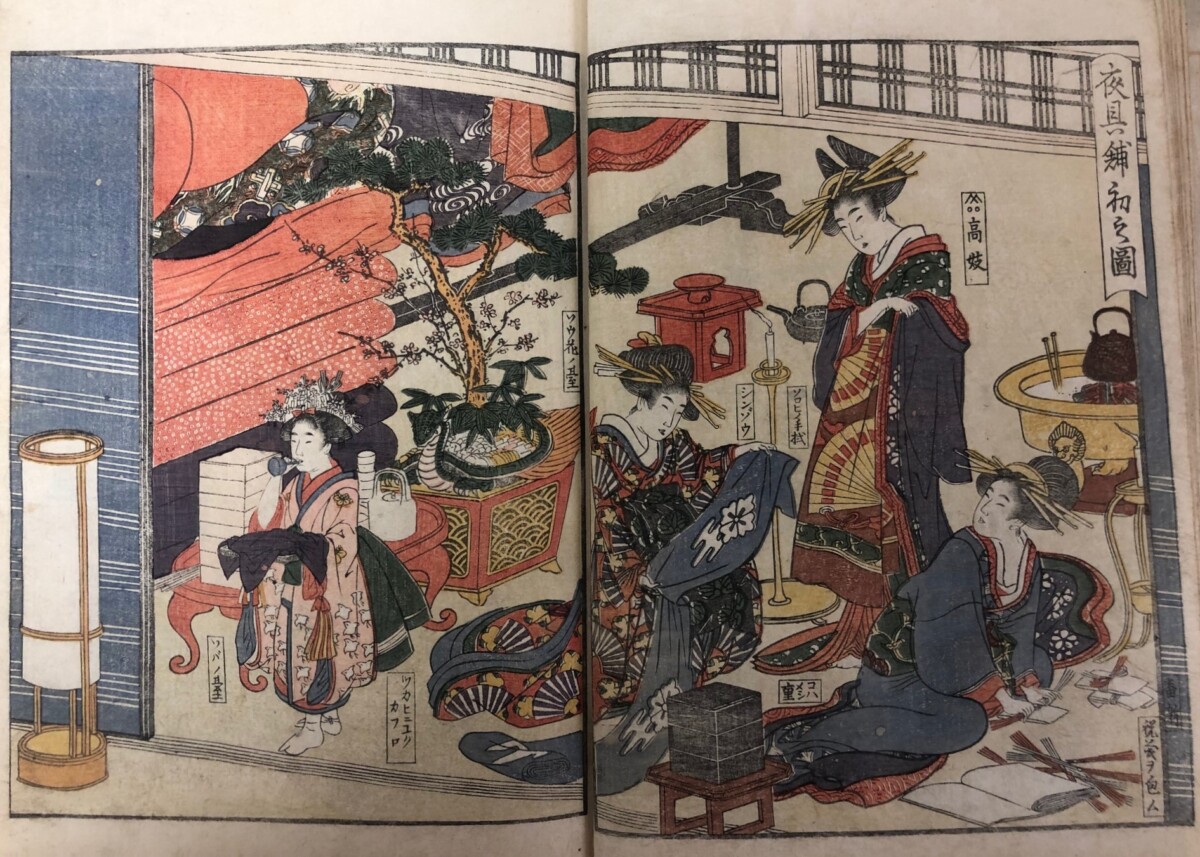
First laying out of bedding given as gifts to the courtesan by her customers.
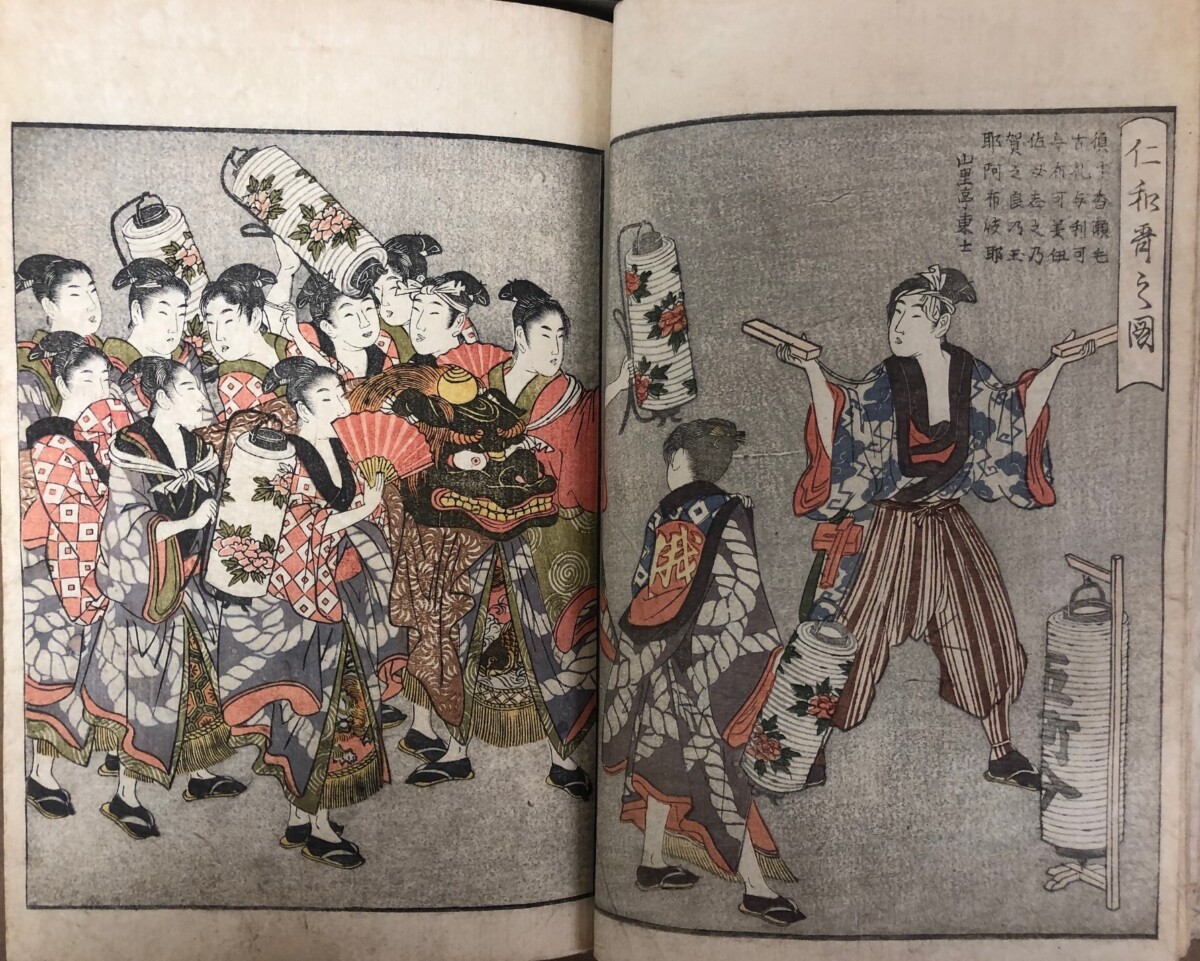
Niwaka Festival, with a parade of women singers, disguised as young boys.
As the title, Picture Book Annual Events of the Green Houses, suggests, the book is about the various festivals and activities that took place at the “green houses,” a poetic euphemism for Yoshiwara. The entertaining text and exquisitely designed images are a peek into the world of the pleasure quarters, with views that, today, can be a bit disturbing. In addition to the depictions of lively street performers and processions of beautiful women in gorgeous robes, for example, there are also scenes of women in “cages” overlooking the street—the “display rooms” of brothels. It reminds us that the women of Yoshiwara we see here and in other Ukiyo-e printmaking, no matter how celebrated they were in literature and art—no matter how skilled they were in the arts or how beautifully they were dressed—were essentially in bondage.
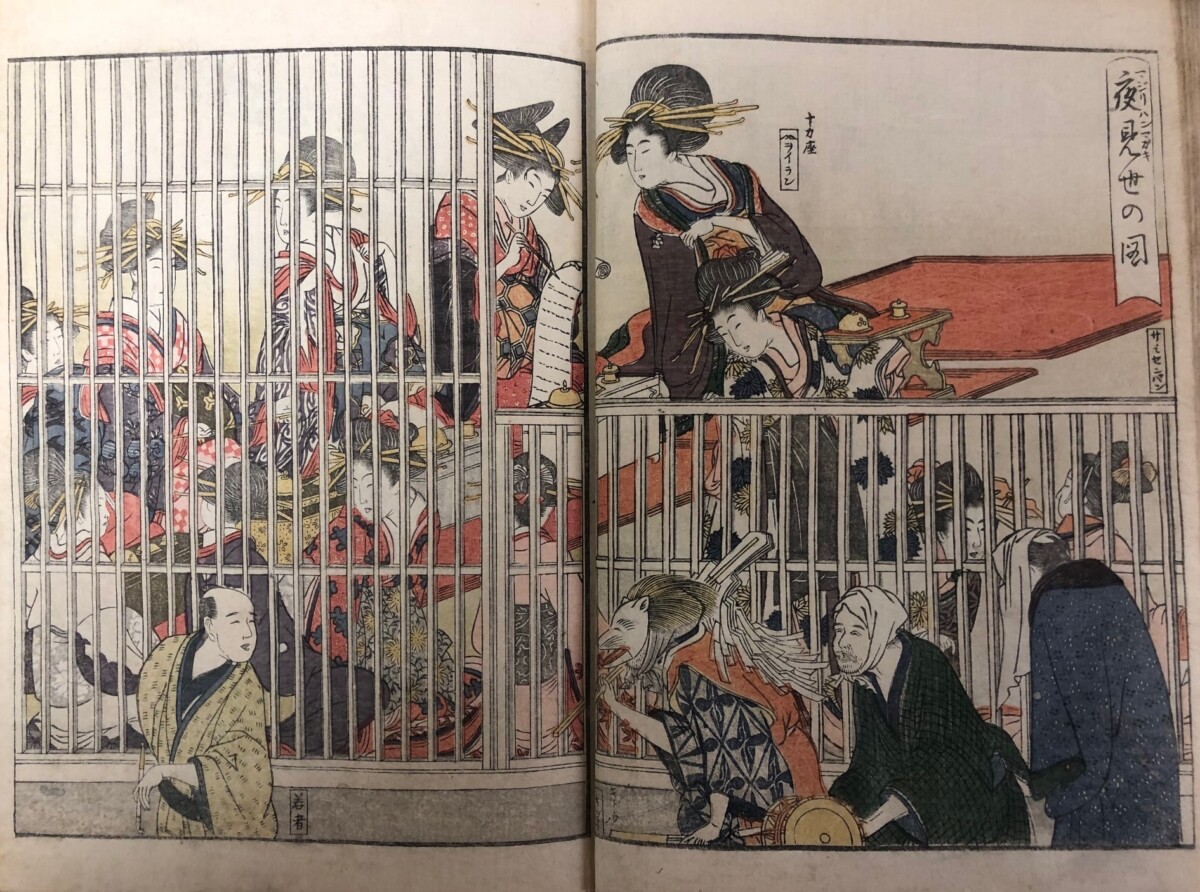
“Display Room” of a house of pleasure.
The original blue covers of Picture Book Annual Events of the Green Houses are embossed with the crests of some of the most prominent Yoshiwara houses of pleasure. Lovely frontispieces with plum blossoms and camellia (vol. 1) and chrysanthemums and a maple branch (vol. 2) are symbols for the seasonal changes taking place within (see above). Most notable is the final image, which is believed to be a self-portrait of Utamaro painting a Japanese phoenix (hō-ō) on the wall of a brothel as curious courtesans look on.
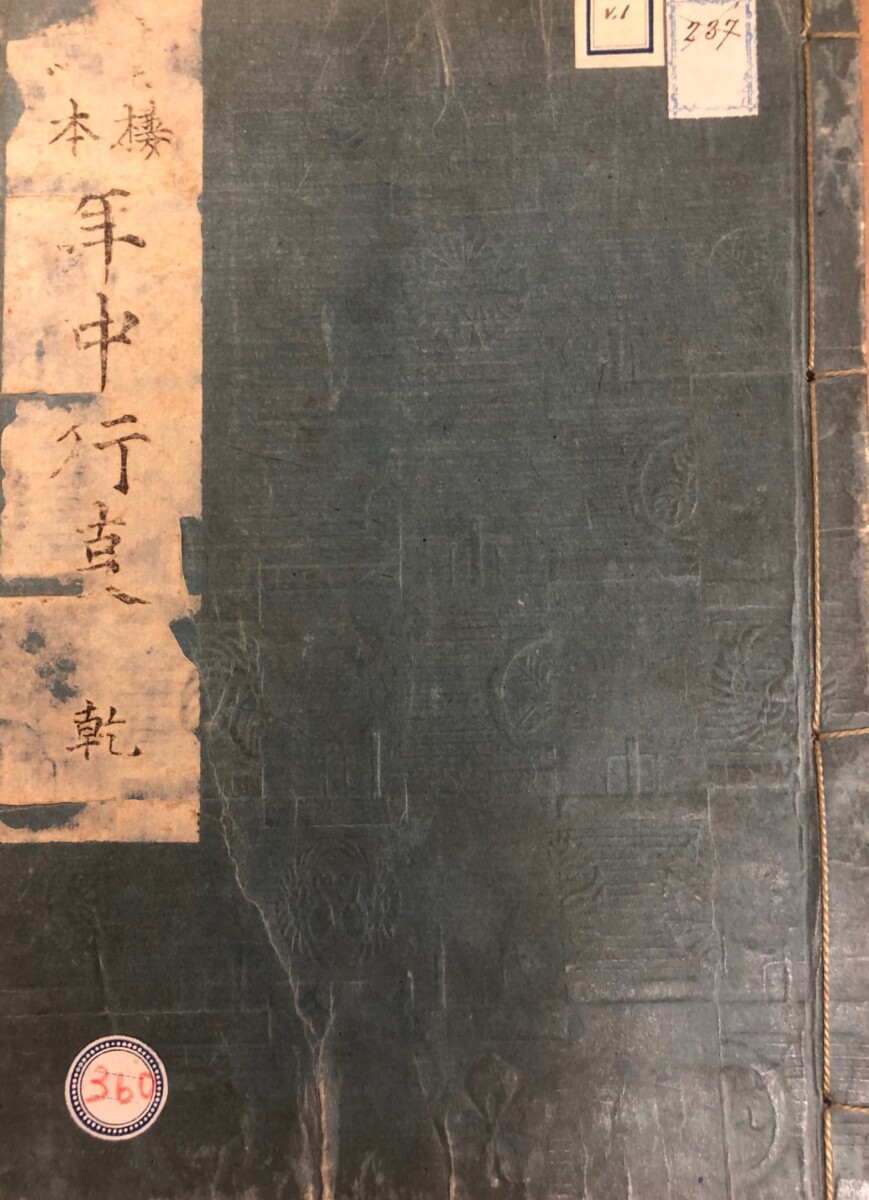
Cover embossed with crests of Yoshiwara establishments.
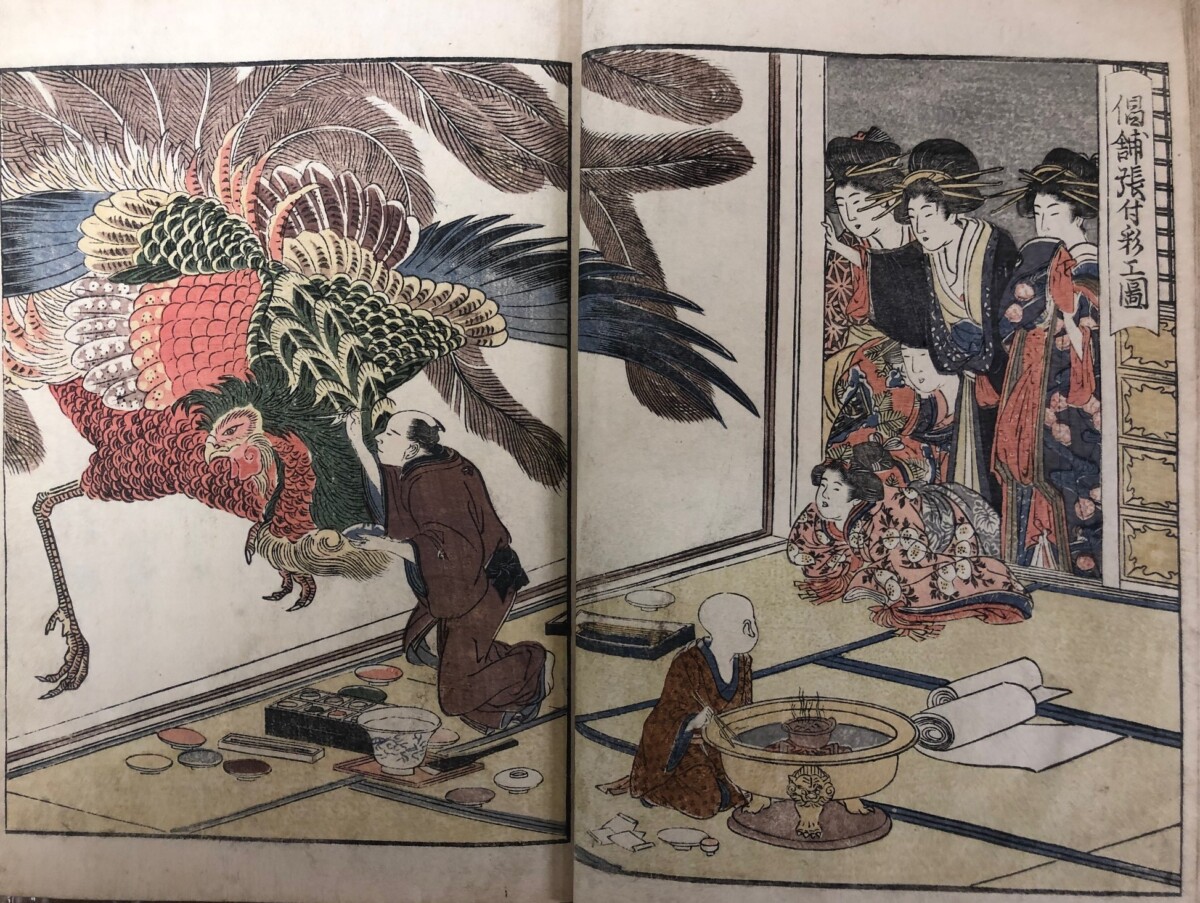
Utamaro “adding colors to the interior wall of a house of pleasure.”
In 1891, the French author, critic and Asian art collector, Edmond de Goncourt, published a monograph on Utamaro, Outamaro—Le Peintre des Maisons Vertes [Utamaro—Painter of the Green Houses], which introduced the artist to France as one of the finest in Japan. He endeared the public to Utamaro by recounting his sometimes-tragic life story and the struggles Goncourt perceived he must have had with his art. Much of this book was then devoted to Picture Book Annual Events of the Green Houses, and included detailed descriptions of each image and long passages discussing the differences between Western and Japanese prostitution, which he described as being elegant and refined. (He describes the “display cages” as “trellised windows facing the street.”) It sparked the public’s imagination and made the book quite famous, even beyond the world of European art collectors.
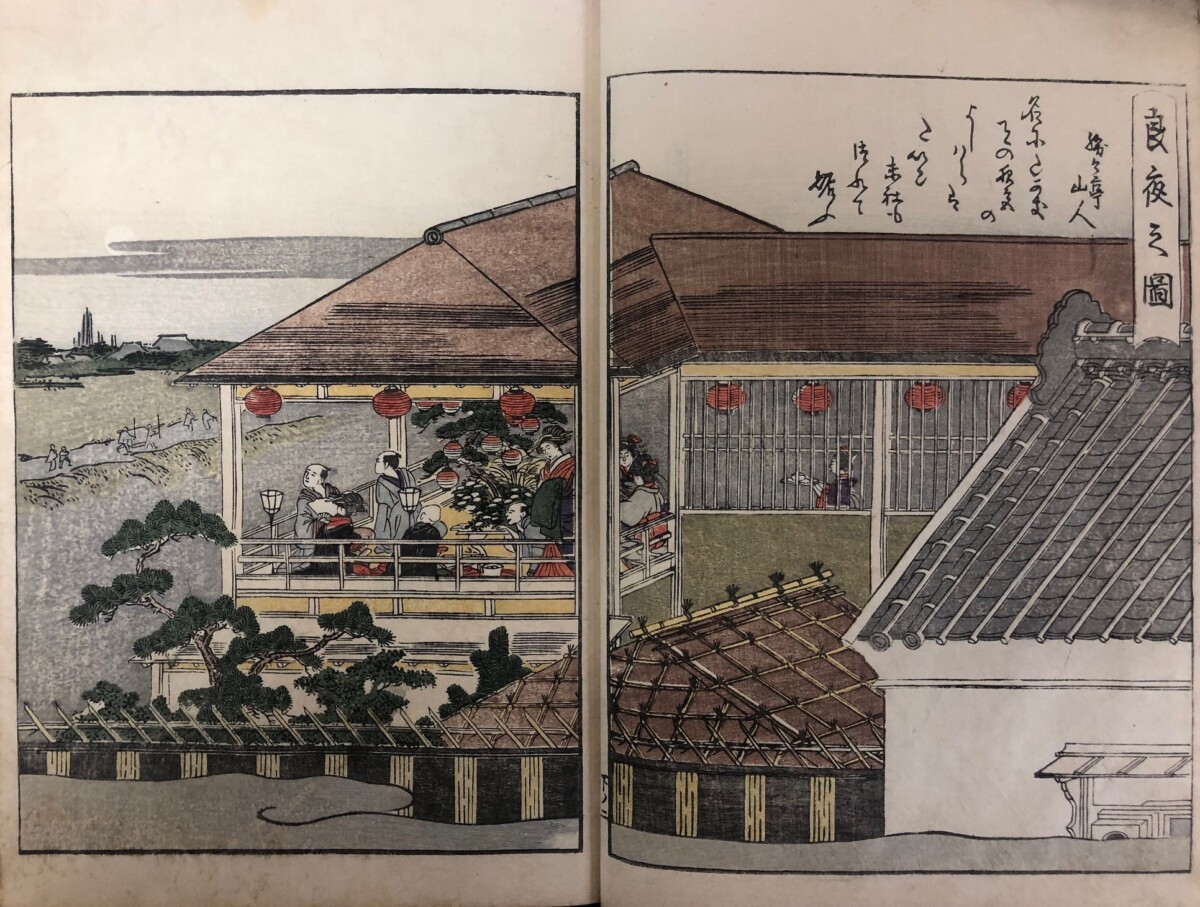
Entertaining on a moonlit night in mid-Autumn.
Goncourt’s translation of Ikkū’s text and his knowledge of Yoshiwara were undoubtedly provided by Hayashi Tadamasa (1853-1906), Goncourt’s art dealer and friend. Hayashi was probably the single most important figure in the popularization of Japanese art in Europe, even referred to in the early 20th-century as “the grand architect of the transformation of the European sense of Japanese art.” [2] He had arrived in France in 1878 as an agent and translator for a company planning an exhibition of Japanese art and stayed to become a famous art dealer and influencer, successfully promoting Japanese prints and books across Europe and America. Through Goncourt’s Outamaro, then, he and Hayashi Tadamasa were instrumental in bringing Utamaro and his wonderful Picture Book Annual Events of the Green Houses to the attention of the Western world.
- [1] Jippensha Ikkū was a prolific writer, best known for Shank’s Mare [Hizakurige], about a journey of two comical characters traveling the Tōkaidō Road, which was the inspiration for Ando Hiroshige’s iconic print series, Fifty-three Stations of the Tōkaidō Road [Tōkaidō Gojūsan-tsugi.]
- [2] Raymond Koechlin in Souvenirs d’un vieil amateur d’art de l’Extreme Orient. (Paris, 1934), p. 9.
- Nicole Fabricand-Person, Japanese Art Specialist