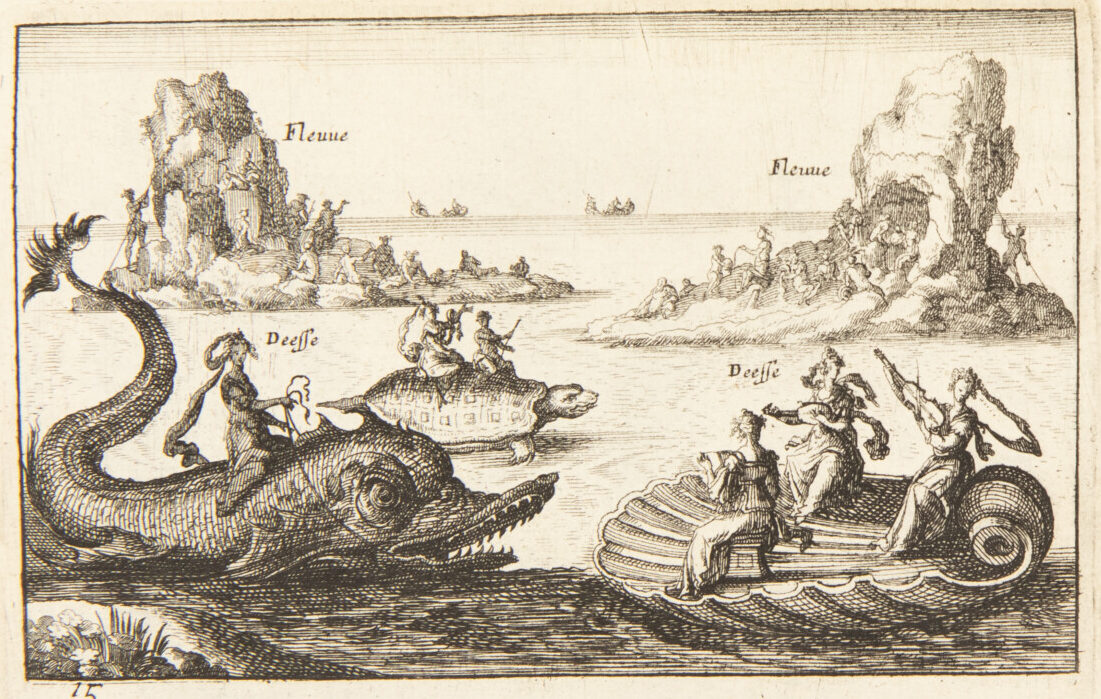
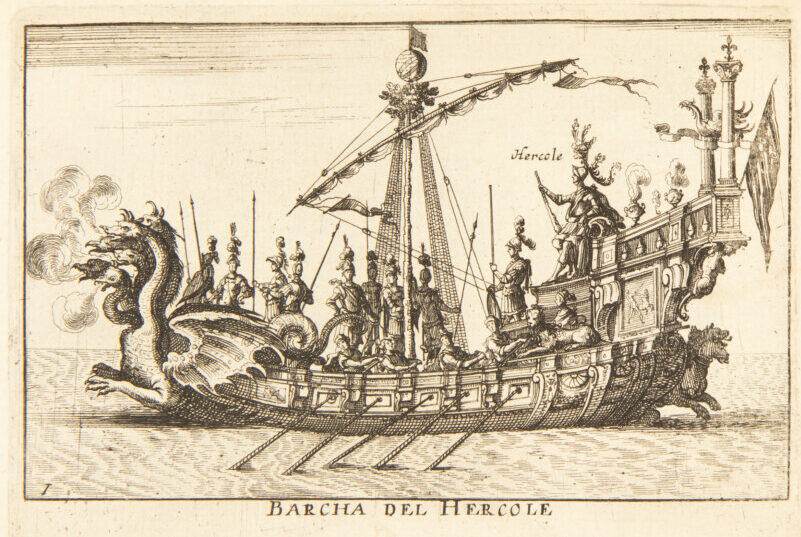
Le Manifique Carousel fait sur le fleuve de l’Arne a Florence, pour le mariage du grand duc. Paris: Chez Balthazar Moncornet, late 17th C. Octavo: 18.6 X 14.3 cm. 19 etched plates: [1] (title) and 18 (scenes from the pageant).
Our newest “Festival Book,” made for the wedding of Cosimo II de’Medici & Maria Maddalena of Austria, is a publication type found in all manner of rare book collections. They were extravagant publications meant to commemorate major ceremonial events of a monarch or ruler.
Our “Le Manifique Carousel fait sur le fleuve de l’Arne a Florence, pour le mariage du grand duc” is a suite of prints dedicated to Sébastien Pontault de Beaulieu (circa 1612-1674), “Ordinary Commissioner and Provincial Controller of the Artillery of the town of Arras and the Pais d’Artois, engineer and geographer of the King”.
The plates depict the mock naval battle with a theme of the Argonauts’ expedition to find the Golden Fleece. The pageant took place on the Arno on the occasion of the marriage between Cosimo II de’Medici (1590-1621), Grand Duke of Tuscany, and Maria Maddalena of Austria (1589-1631), on 3rd November 1608.
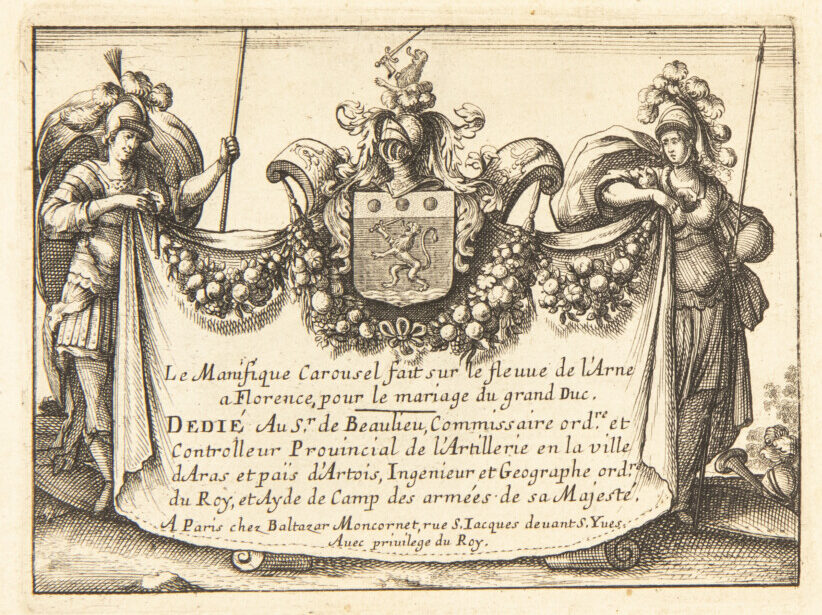
This book was produced in Paris, with a dedication to the engineer and geographer of the French king- Louis XIII at the time of earlier editions. Two later editions were made while Louis XIV was king. Evidence points to our edition as being one of the earlier due the size and dedication. The ensemble was published with a double purpose: to perpetuate the memory of one of the great Florentine festivals, and to provide a possible source of inspiration for celebrations at the French court.
Such spectacles appealed to Louis XIV, and this book could have been used as a source of inspiration by his own creators of festivals. The boats were each captained by a god: Hercules, Amphion, Castor and Pollux, Thetis, Polyphemus and Palaemon, Cupid, etc.
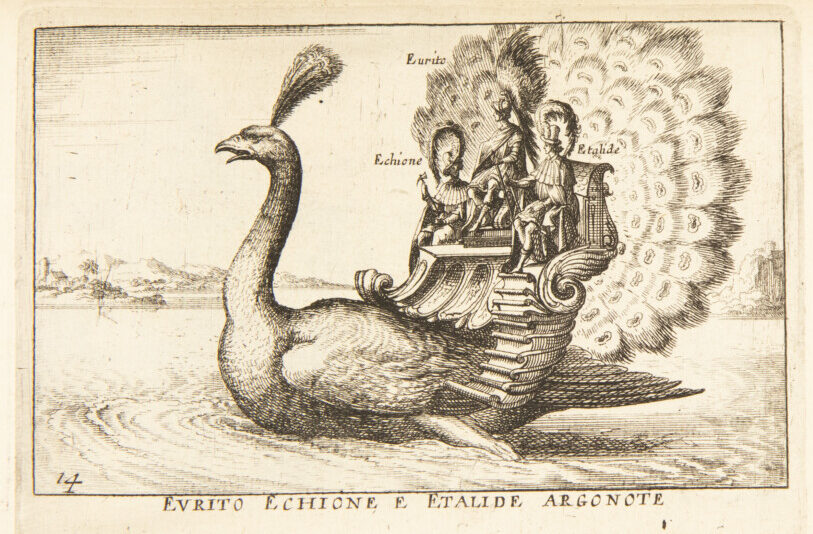
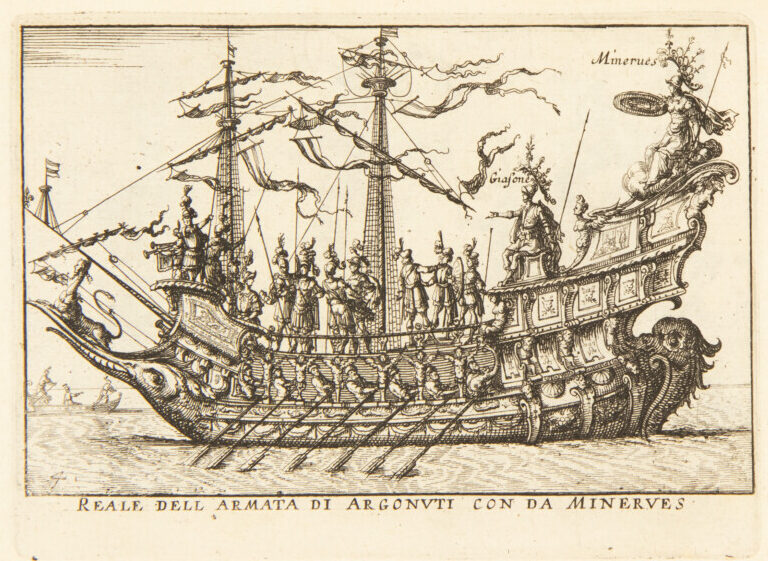
This event was easily the most important of the wedding festivities and employed massive numbers of craftsmen, costumers, technicians and artists. Giulio Parigi, Jacopo Ligozzi and Ludovico Cigoli designed most of the theatrical performance, of which a series of etchings of the ships also survives. The bridge of Santa Trinità was transformed into the city of Colchis, complete with crenelated castles and towers.
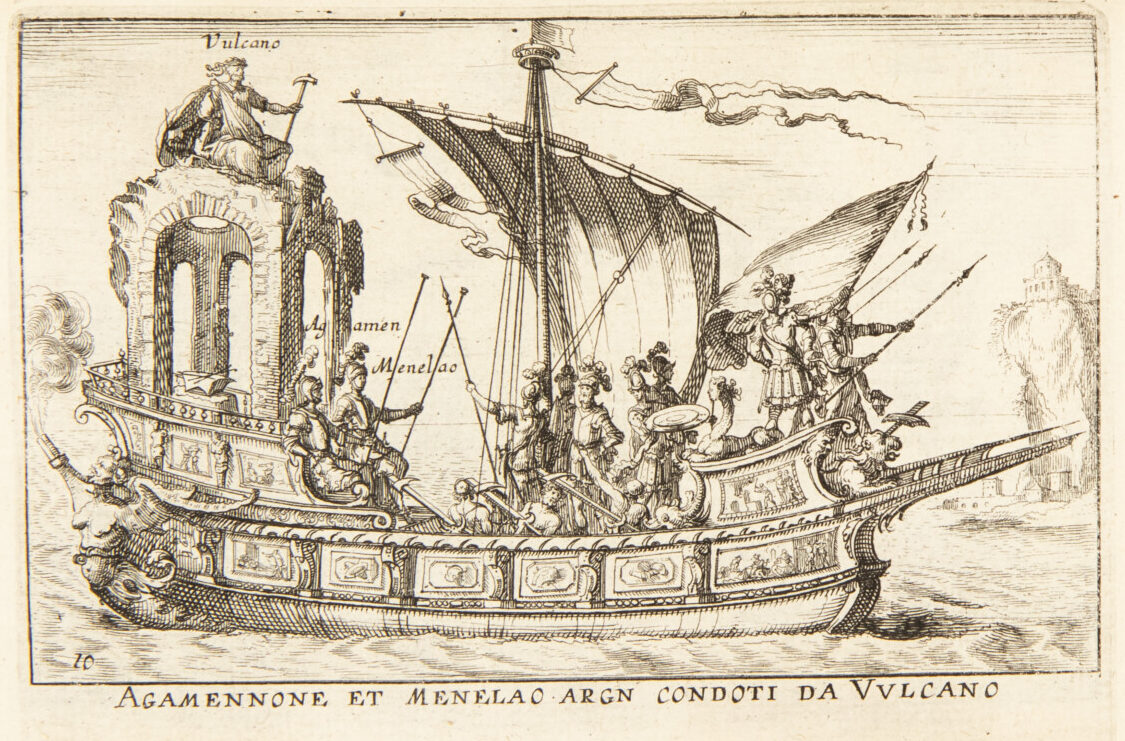
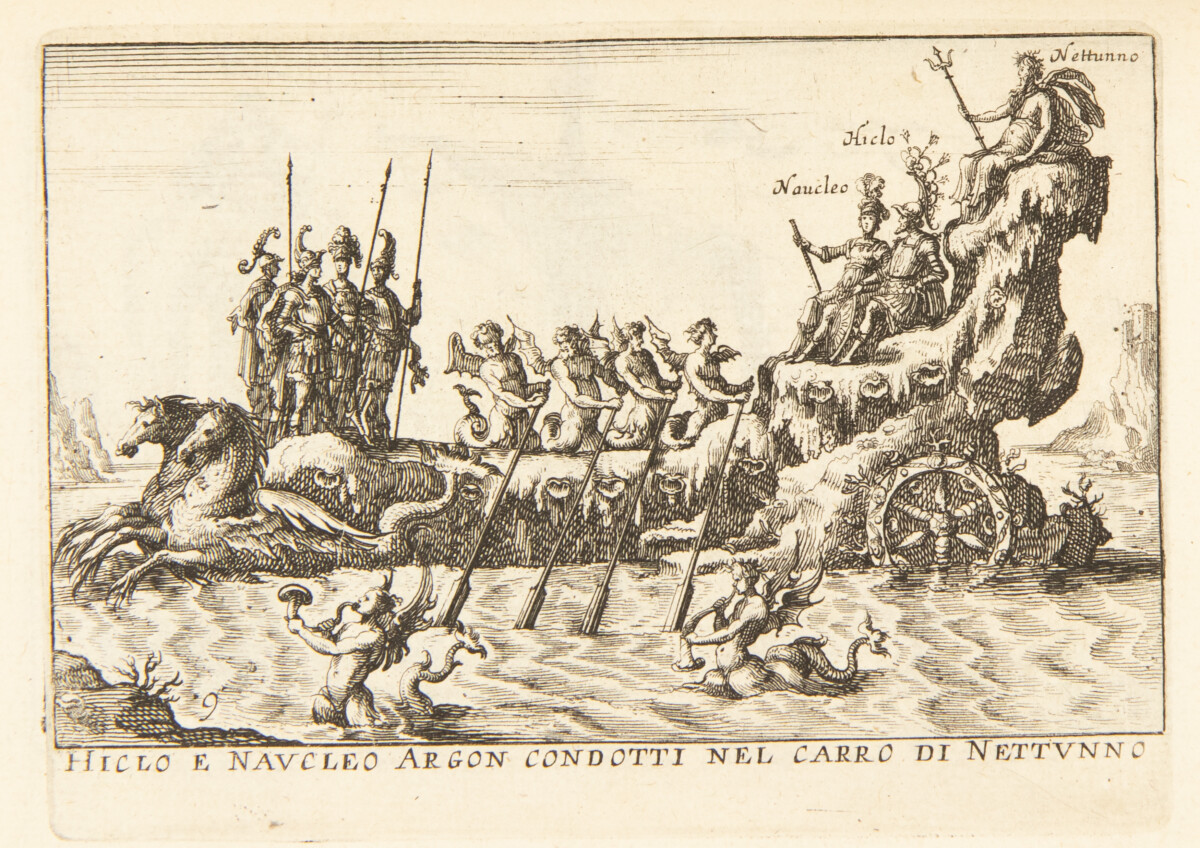
In front of the bridge, an island in the middle of the river provided the setting for a small temple that housed the Golden Fleece. The event took place at night and was lit by torches that burned at both sides of the river. “The richly appointed captain’s ship of the Colchis armada appeared first from the Carraia side and took his sixteen galleys on a tour of the theater, “to survey its territory.” Then Jason’s magnificently carved and painted galley appeared from the Santa Trinità side, full of exquisite and exotic details, and led the twenty-six galleys of the Argonauts, each uniquely decorated, for an even more pompous tour of the ensemble.
Our new acquisition garnered much faculty support including Associate Professor of French Volker Schröder,—who often teaches with our many publications on Versailles—stated:
“This precious little suite is a wonderful addition to Princeton’s outstanding holdings of early modern European festival books. It provides a missing link between the pageantry of the Medici court and the fêtes of the young Louis XIV. I am particularly intrigued by the connections between these images and the 1664 “Pleasures of the Enchanted Isle,” the first major entertainment staged in Versailles, which included sea monsters and was in turn documented in a famous album of etchings by Israel Silvestre.”
Find this reference in the PUL online catalog.
Marquand has many other books about Medici festivals in this period including:
Esequie fatte in Venetia: an Account of the funeral of Cosimo d’Medici II, Grand Duke of Tuscany, held in Venice, Italy, May 25, 1621. Find here.
1625: Visit to Florence of Władysław IV Zygmunt, Prince of Poland; complete with jousting and horse ballet organised by Cardinal Gian Carlo de’ Medici. Find here.
Celebrating Marie de Medici (Queen, consort of Henry IV, King of France, 1573-1642) arrival in Amsterdam (1638). Find here.
Find our featured book in our online catalog.
Holly Hatheway
Head, Marquand Library of Art & Archaeology