Antiphonarii Ordinis Cartusiensis ad exemplar Maioris Cart. Castigati Pars Hyemalis et Pars Aestiva.
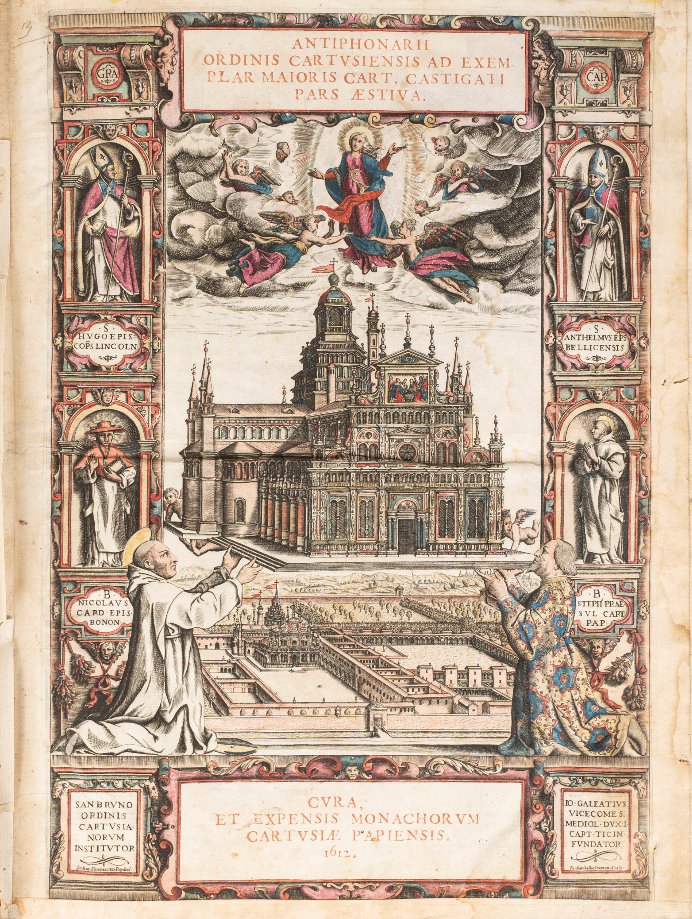
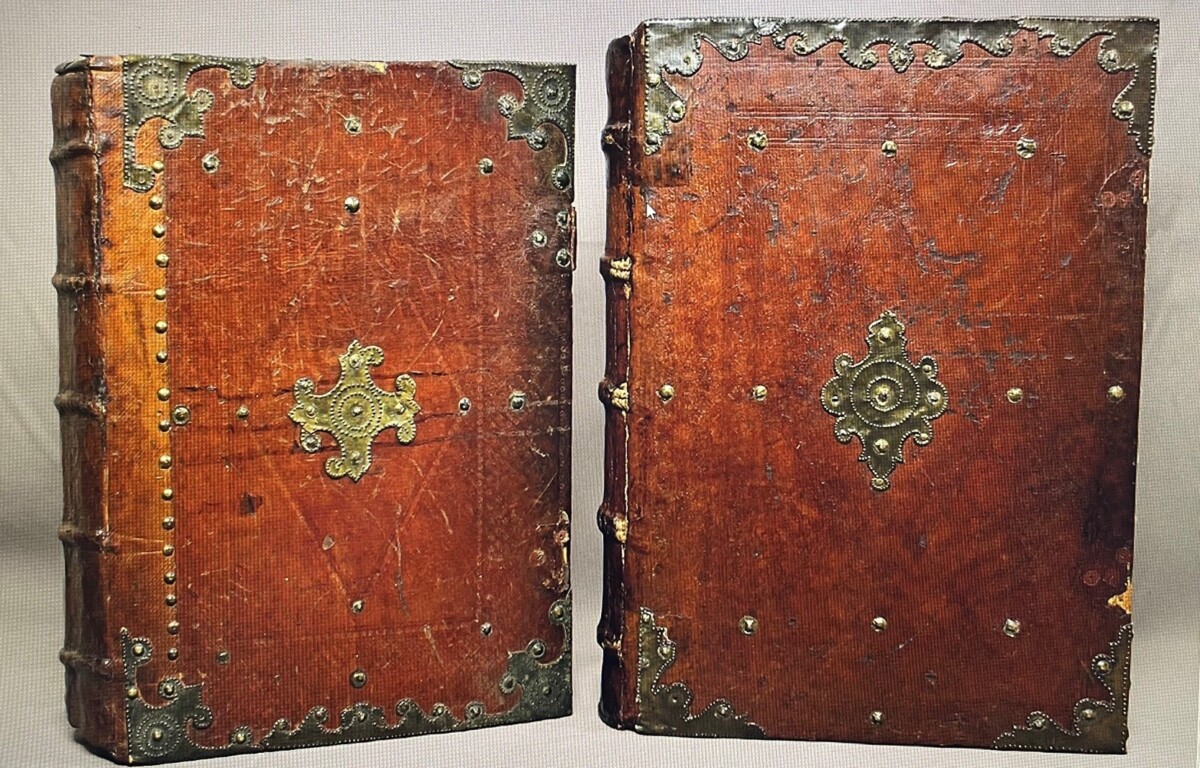
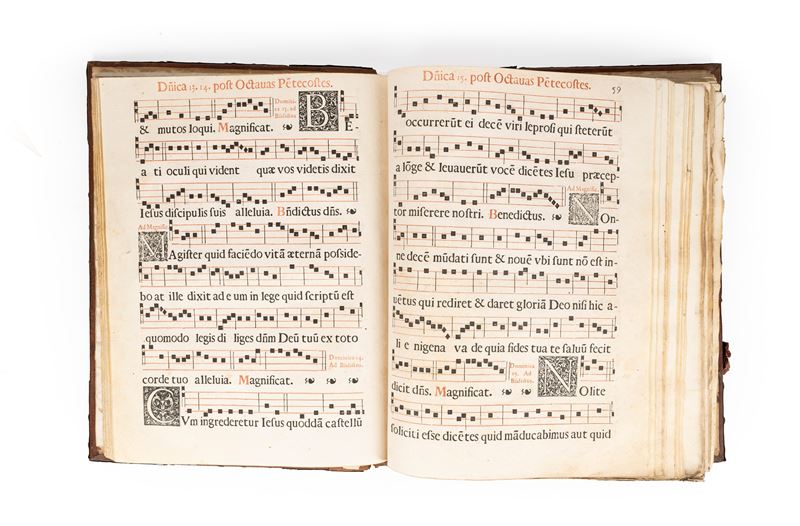
This monumental, 2-volume Antiphonary, a recent acquisition by Marquand Library, was published between 1611-1612 in the Certosa of Pavia, near Milan, for the use of the Carthusian monks there. The publication consists of two parts, the Pars Hyemalis (for winter) and Pars Aestiva (summer), which contained the liturgical music, such as antiphons, responsories and hymns, chanted and sung to celebrate the daily canonical hours throughout the church’s calendar year. Both folio volumes are bound in contemporary calf over wood, with metal ornaments that were partly decorative and partly protective of the edges of the the weighty books. The large format was designed to make the musical score more legible for the monks who gathered around the lectern on which it was placed, though memorization of the chants supplemented the visual cues of the musical scores.
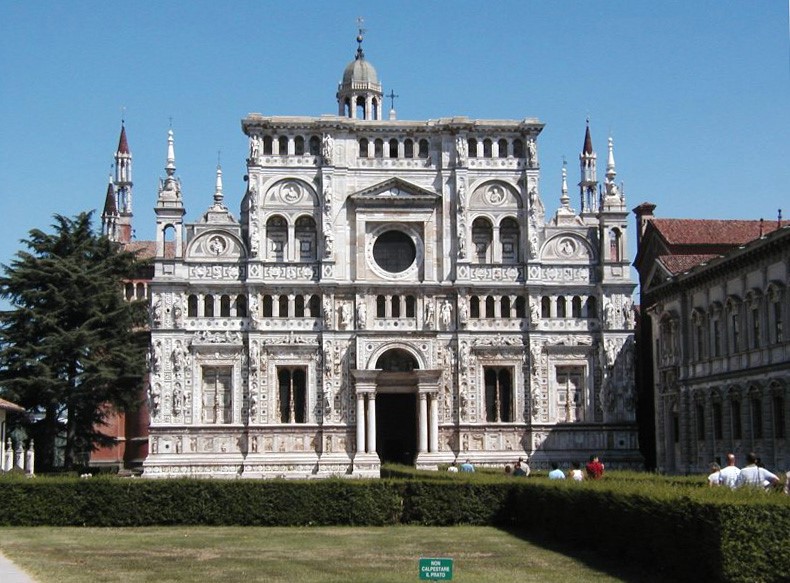
Founded in 1396 by Gian Galeazzo Visconti, first duke of Milan, the Certosa was intended to serve as the family mausoleum of the Visconti. The magnificent title page of each volume of the Antiphonary depicts Gian Galeazzo and Saint Bruno, founder of the Carthusian order in 1044, kneeling and lifting an enormous model of the church upwards to offer to the Virgin, to whom the Certosa had been dedicated. The church itself was finally consecrated in 1497. While the title page for the Pars Aestiva was hand-colored, the one for the Pars Hyemalis was left uncolored. In the background below the model of the church is a detailed depiction of the expansive monastic complex, which was not completed until the mid-sixteenth century.
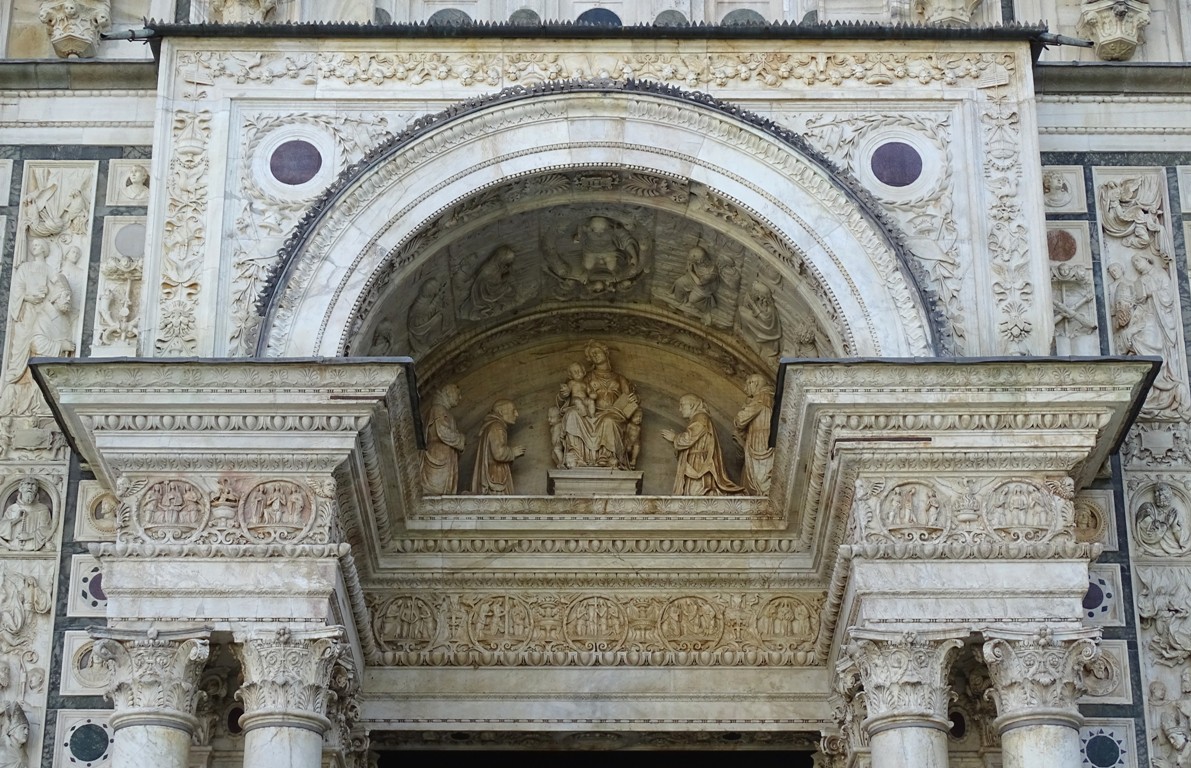
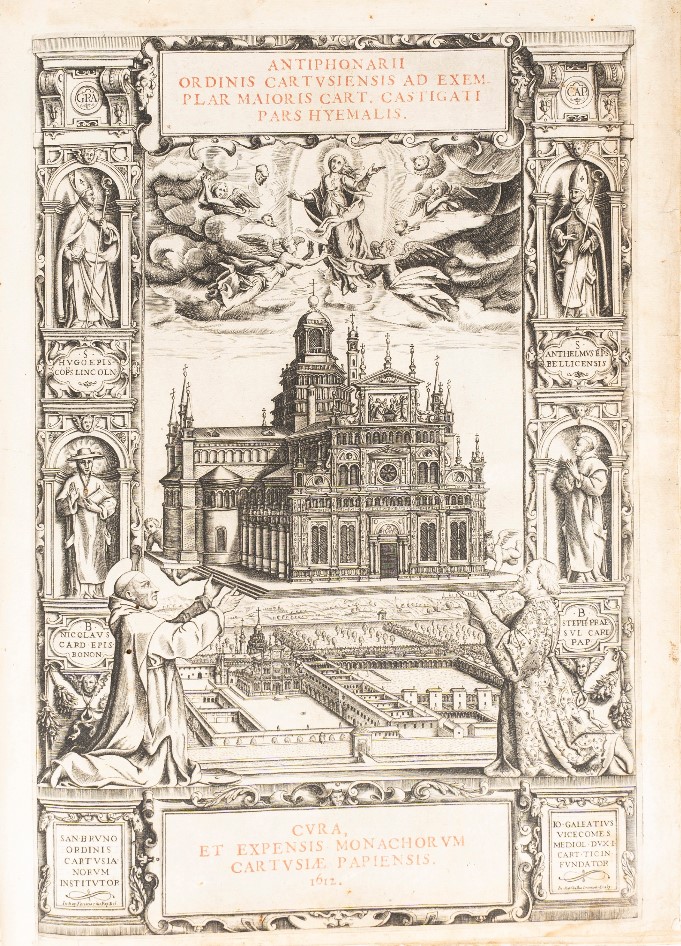
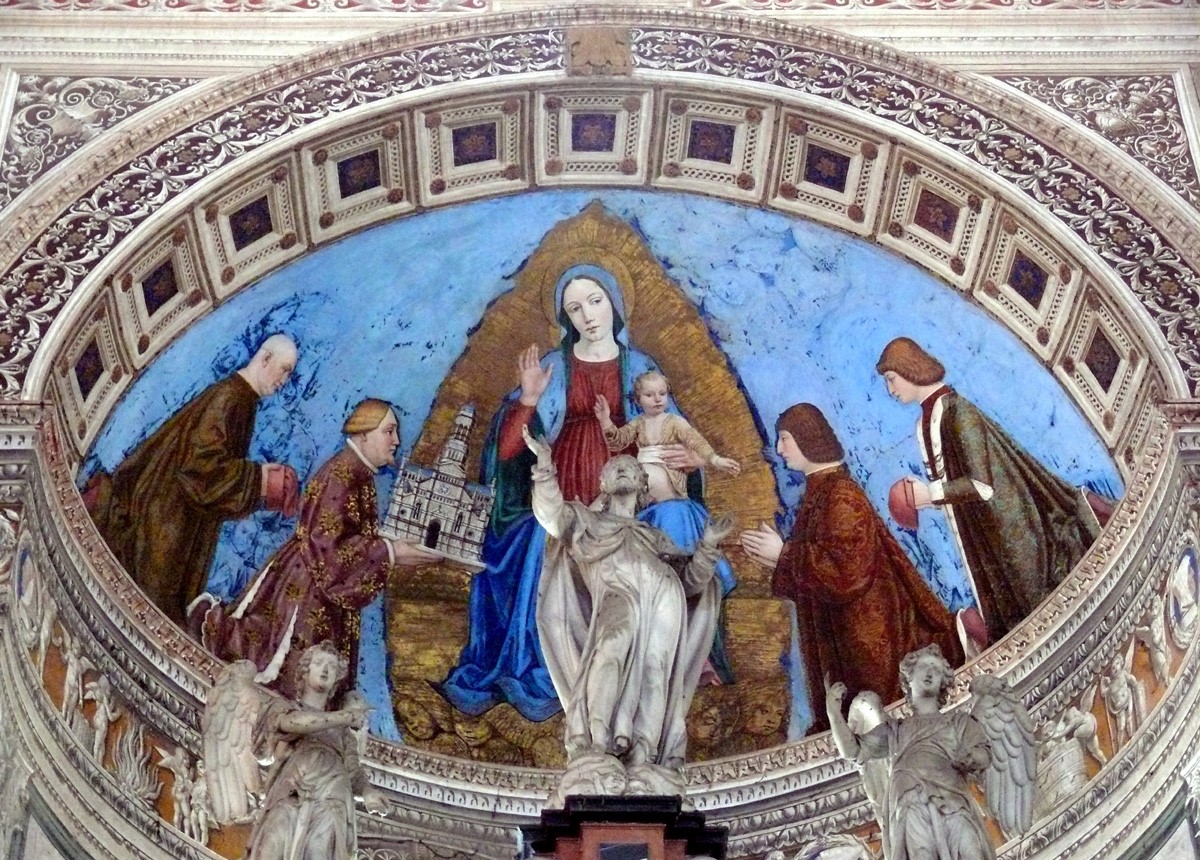
The interior of the Certosa was as lavishly decorated as the exterior, which was an eclectic mix or styles from different periods. The title pages of the printed early seventeenth-century Antiphonary reflect earlier imagery found on both the exterior, with its many carved donor figures and saints in arched niches, and decorative inlays of colored stones, and in the fresco by Ambrogio Bergognone, dating from the ca. 1490-1495, located in the right transept of the church, depicting Gian Galeazzo Visconti, flanked by other Visconti and Sforza family donors, offering the model of the church to the Virgin and Child.
In 1560, Piero Sardo, Prior General of the Carthusian order, had established a printing press in the Certosa complex for printing the Breviarum secundum ordinem cartusiensem that same year. After the 1560 Breviary, only a handful of other Carthusian liturgical works are known to have been printed there during the 1560s, and they were supposed to be available for distribution to other Carthusian houses, if needed. By the time the Antiphonary was commissioned, the press had not produced anything for over forty years, and almost certainly lacked skilled printers for such specialized and costly work. What is particularly interesting about this publication is that by delving into the extensive publications of the records of the Carthusian order it was possible to discover the identity of the printer responsible for the 1612 Antiphonary. We find that a specialist in printing large-scale antiphonaries was requested from far beyond the Carthusian community in Pavia: Dom Michel de Hove (or Dehove), prior of the Charterhouse of Mont Saint-André, Chercq (near Tournai, now in Belgium) arrived in Pavia in 1609 to use the press for this purpose until he was finally permitted to return to Tournai in 1612 after the publication was finished.[1] This information is corroborated by a Belgian publication about the Charterhouse of Mont Saint-André, Chercq, and this source also provided evidence of De Hove’s prior projects: in 1606, he had already produced the letters needed for printing “four large responsiers,” each of two volumes, supposedly by melting down old candlesticks and pieces of copper, and he was given permission to take these metal letters to Pavia to use for the printing of their Antiphonaries (1612)[2].
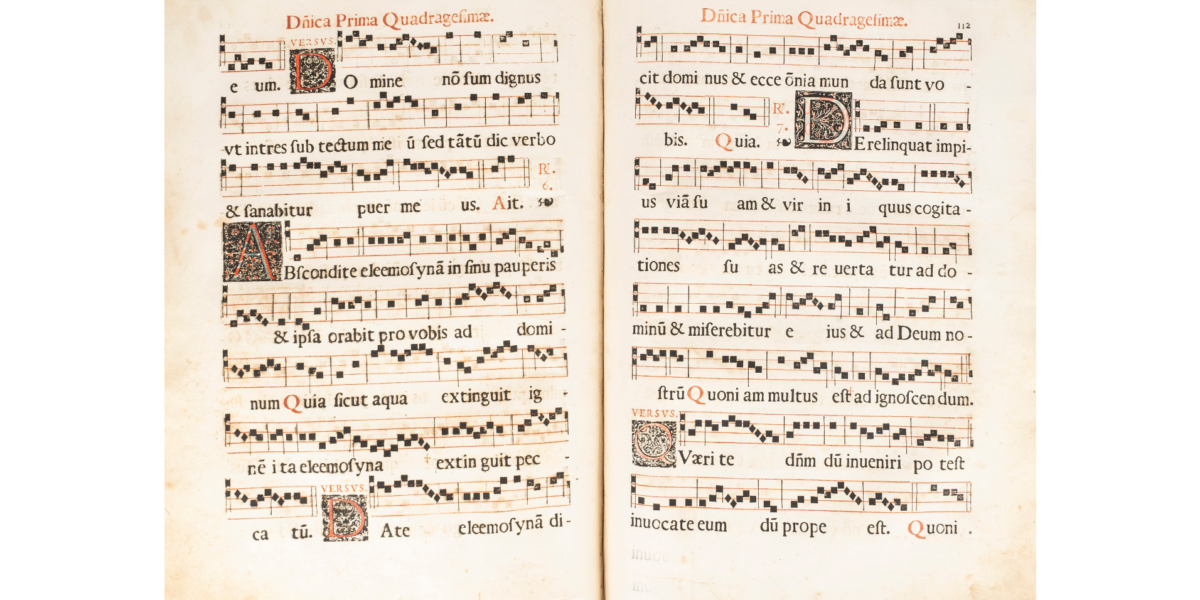
Though Michel de Hove was responsible for printing the musical notation with black square neumes on a red stave of four lines, and the text, printed in red and black with large woodcut initials, some with hand-coloring, the frontispiece was the work of other artists — the engraver Giovanni Antonio Gallo after a drawing by Giovanni Battista Tassinari, in black and red, with the added hand-coloring for the summer volume only.
De Hove’s expertise with this type of printing and his obligation as a fellow Carthusian to serve his order wherever and however he was needed may explain the decision to bring in a printer who was based over 600 miles away for this relatively time-consuming project. At this date, antiphonaries and other precious liturgical books that were required only in small numbers were still being produced in manuscript form (also time-consuming but unique, so appealing to particular patrons or for specific, small-scale use). Setting type for the reproduction of musical scores was more complex than for most regular texts and might not be justifiable unless a need for multiple copies was anticipated and a skilled printer and existing press were at hand, as occurred here. We know that copies of this printed publication — a technologically advanced innovation — were supplied to other Carthusian houses but we do not know how many copies were produced or where they were sent.
Few examples of both volumes appear to have survived. In addition to the pair now in Princeton University Library, copies of both volumes are located in the library of the Buonconsiglio Castle in Trento, the Bayerisches Staatsbibliothek in Munich, and the collection of the Cartoixa de Santa Maria de Montalegre, Catalunya, and single volumes are held in a few other European institutions. In the United States, copies of the Pars Hyemalis are recorded by WorldCat in the libraries of the University of Iowa and Case Western Reserve University, Ohio.
After its suppression by the Emperor Joseph II in 1782, the Certosa fell into decline and changed ownership many times, but is now in the care of the Direzione regionale Musei nazionali Lombardia.
Nicola Shilliam, Western Art History Bibliographer
[1] James Hogg, The Charterhouse of Pavia as seen in the Chartae of the Carthusian General Chapter. Analecta Carthusiana, 100: 51 Salzburg (2010), p. 182, n. 775: 1612: “(In domo Papiae). Et domnus Michael Hoiie, professus domus Tournaci, revertatur ad dictam domum suae professionis. (Est qui curavit antiphonaria typis mandanda).” n. 775 [“(In the house of Pavia). And let Lord Michael Hoie, professed in the house of Tournai, return to the said house of his profession. (He is the one who took care of the antiphonaries that were ordered to be printed).”
[2] See F. Demons, La Chartreuse du Mont Saint-André a Chercq près de Tournai, 1375-1783,” Annales de la Société historique et archéologique de Tournai, nouv. sér., Tome XIV (1907), pp. 140-141: “Michel Dehove, né à Mauberge, profès de Cherq, sacristain, recteur en décembre 1599, prieur le 1er mai 1600. S’occupe de l’impression des grands antiphonaires carthusiens. Envoyé en 1609 à la chartreuse de Pavie pour s’y consacrer à l’impression de ces antiphonaires. Après son retour d’Italie, il fut vicaire de la chartreuse de Cherq où il mourit le 25 juillet 1630.”